Paddle Options
Design your Greenland Paddle for your unique preferences.
The options below can be applied to any style paddle I craft.
Solid or Laminated
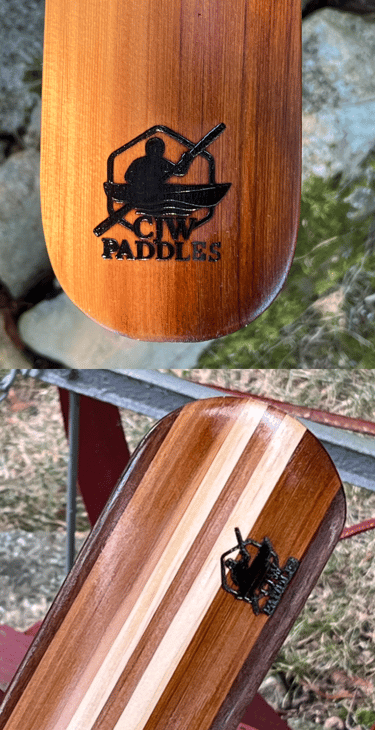
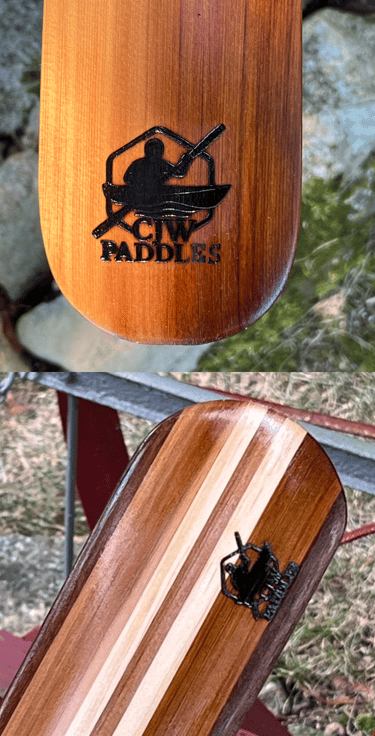
Solid paddles are crafted from a single piece of lumber, typically a two-by-four (which in reality only measures 1-1/2" x 3-1/2") of appropriate length. Laminated paddles are crafted from multiple woods which are glued together to create the starting blank from which a paddle is carved. Lamination involves mixing different species and colors of woods to create unique paddle designs. The most common designs are vertical (stripes) and/or horizontal (layers). Lamination can involve gluing as few as two pieces of lumber together or as many as nine strips of wood -- more complex glue-ups can create very attractive patterns within the paddle.
Visit the Lamination Styles page for examples of paddles designs that can be crafted.
One Piece or Take-Apart
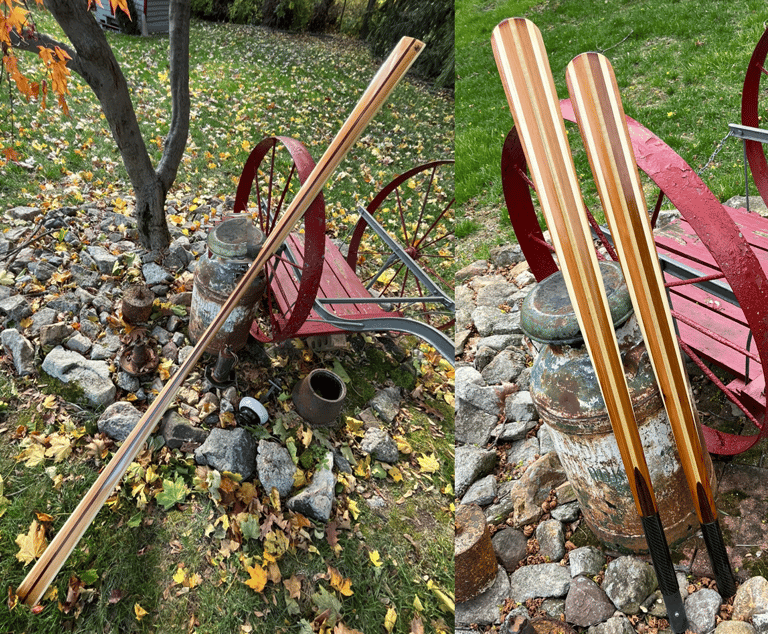
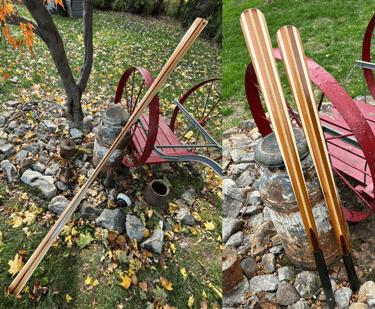
One piece paddles are great for performance and durability. They can often be a bit lighter than a take-apart paddle due to the added weight of the carbon fiber ferrule. However, they can be harder to transport or store on the deck as a spare due to their length. One piece can be stronger and ideal for performance situations that can place stress on the loom.
Take-apart paddles excel for portability because the two halves can be separated. The ferrule is made of carbon fiber and can be easily joined and separated. Take-aparts are especially great for storage on your deck as a spare paddle. Like all paddles, the ferrule should be thoroughly rinsed with fresh water and allowed to dry. I offer two styles of carbon ferrules - a premium Gearlab ferrule and a general purpose ferrule.

Shoulder Style
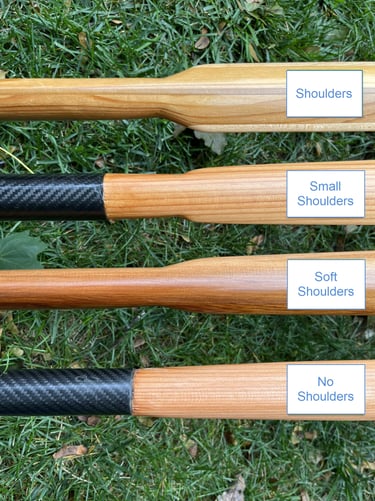
Paddles can be crafted with distinct shoulders, small shoulders, soft shoulders, or no shoulders. If you’re new to using a Greenland paddle, perhaps start with a small shouldered or soft shouldered version. The shoulders help position your hands properly just by feel and are also very useful when executing the canted stroke, as the pressure from your fingers wrapped around the shoulders naturally cants the paddle blade to the correct position. Shoulderless paddles are very comfortable to hold and make for seamless Slide Strokes as there is nothing impeding your hands along the length of the paddle.
If you're undecided, soft shoulders help balance best of both styles. Also, it's fairly simple for an experienced Greenland paddle builder to sand your shouldered paddle to either a soft or unshouldered style (keep in mind this only works one way - it's much more difficult to recreate shoulders from an unshouldered paddle without impacting loom length). Note that modifying shoulders after purchase may require sanding and reapplication of the paddle finish.
Tip Style
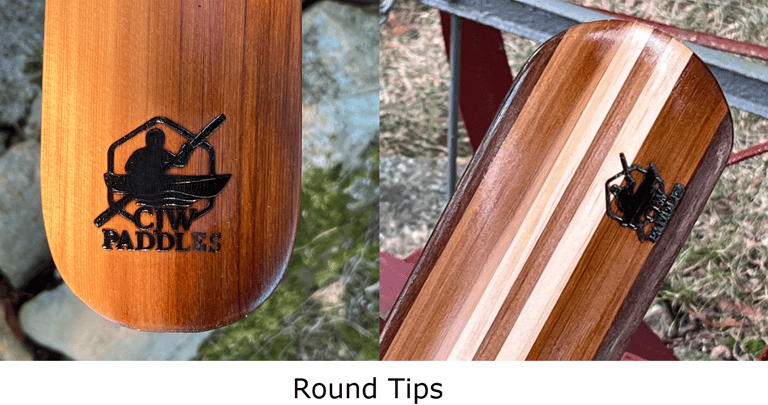
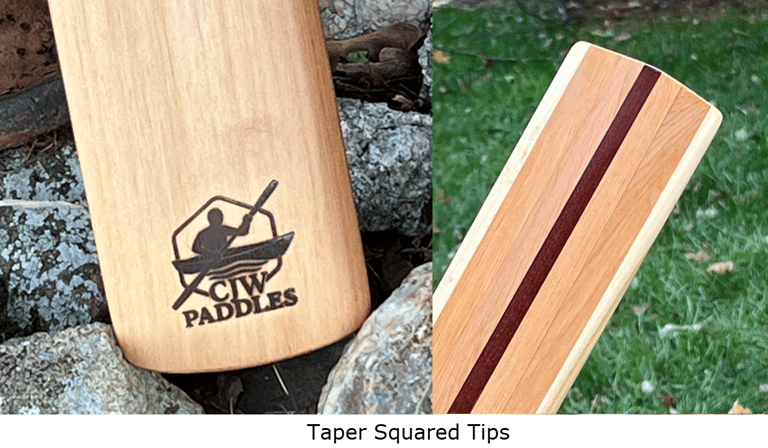
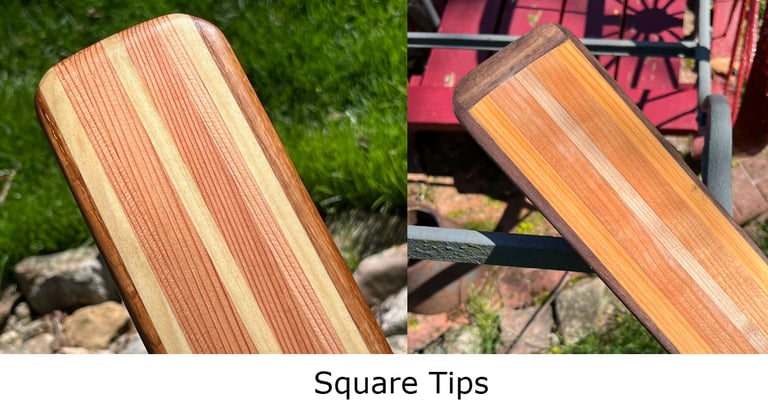
This is purely a personal preference choice. There are some who feel that rounded tips are quieter. Rounded tips are also less likely to chip, since there are no corners. Not to worry, it's fairly easy to sand your tips to a different shape after-the-fact (of course you may sacrifice a small amount of overall length doing so). Modifying tips after purchase may require sanding and reapplication of paddle finish.
Wood Choice
The lightest wooden Greenland paddles tend to be crafted from Western Red Cedar which is a fairly soft and easy-to-carve material. Besides its terrific color and aroma, paddles crafted using this wood tend to balance weight and strength for a light and durable paddle. Western Red Cedar color and grain pattern can vary from paddle to paddle.
However, the ancient Inuit of Greenland crafted their paddles from whatever wood was available to them. There were no lumber yards to hunt through in pursuit of the perfect piece of wood with the proper grain direction and weight. If they needed a paddle, they simply built a paddle from what they could find. Today, choice of lumber material is a matter of personal opinion, preference, weight, and availability. Considerations include expected use, performance vs functionality, and cost which are all important factors.
Western Red Cedar is light and strong but solid pieces of quality lumber sometimes takes more time to find
Douglas Fir, Whitewood, and Pine are heavier than Cedar but less expensive and easier to find however, finding straight grained and knot-free pieces can be a challenge
Lamination, which combines multiple pieces of woods, helps to overcome the difficulty of finding quality 2" x 4" solid lumber. Lamination also balances strength, weight, and style by incorporating stronger hardwoods with softer woods, often of varying colors, grain direction, design patterns.
Visit the Wood Choices page for comparison of woods commonly used in my Greenland-style paddles.
Finishes
My Greenland, Greenland Storm, and Norsaq Rolling paddles can be finished with 100% Pure Tung Oil or a 50/50 mix of Pure Tung Oil and marine-grade Spar Varnish. Tung Oil creates a warm natural finish and hand feel and offers excellent water protection. Spar Varnish creates a nice durable finish but feel less natural. The 50/50 mix balance the best of both. My application process is as follows:
Sand the paddle using increasingly finer grits
Thoroughly wet it down with water to raise the grain
After it dries, I sand it with even finer grits to knock off the raised grain
Several more sanding sessions create a very smooth surface
Apply finish with a foam brush
Let it soak in for 15-20 minutes
Wipe off the excess and let it thoroughly dry (cure)
Repeat steps 5, 6, and 7 multiple times
Let the paddle cure for 1-2 weeks before use
For Decorative Wall Paddles that will be put on display and not used in a kayak, I offer multiple choices of finishes. Since these paddles will not be exposed to water and "hand feel" is not a priority, protection is not as critical. Here are some of the choices:
100% Pure Tung Oil brings out the natural wood grain and color - I typically don't stain when using oil
Stained with a satin polyurethane finish changes the color of the wood, shows the wood grain, and offers protection
Unstained with a satin polyurethane finish displays the natural color and grain of the wood while offering protection
How do you choose from all these options?
One easy way to help decide between the different paddles options is to look at your expected use.
How will you be using your new Greenland paddle?
Will it become your favorite kayak accessory that accompanies you on every one of your journeys?
Will it become your new Greenland Roll buddy?
Where do you go with your paddle?
Are you looking for a unique and memorable gift for a friend, loved one, or even yourself!
A good performing paddle that will be used for very long excursions may necessitate a lighter, fine-tuned paddle crafted from Western Red Cedar (or Carbon Fiber). If you're a frequent paddler in varied waters, perhaps a laminated paddle balances strength and weight. Laminated paddles also are a great paddling conversation starter! If you plan to travel with your paddle, a 2-piece take-apart with a carbon fiber ferrule is easy to transport or ship.
On the other hand, if one is going to use their paddle in rough terrain or simply want a budget-friendly option to get from point A to point B, then perhaps a less expensive wood, like Whitewood or Fir might be an option for you. Though heavier than Cedar, these woods also make great entry-level starter paddles if you're on the fence about investing in a higher-priced Greenland paddle.